
Overview
Today, synthetic DNA is produced through a combination of advanced laboratory assembly technologies. Together, they enable molecules that would take longer or be impossible to obtain through traditional biological workflows.
Biotechnology companies use synthetic DNA to develop and manufacture a wide range of therapeutics, including mRNA medicines, antibodies, and engineered viral vectors, such as lentiviral or adeno-associated viral (AAV) vectors engineered for cell and gene therapies. Beyond therapeutics, synthetic DNA is also utilized in basic and applied research, enabling targeted genome modifications to treat diseases, enhance industrial strains, or introduce advantageous traits into crops.
What is Synthetic DNA?
Synthetic DNA is fully functional DNA made entirely in the laboratory. This feat is accomplished by breaking down DNA molecules into building blocks called oligonucleotides and carefully putting them back together to form a DNA strand. In some cases, the DNA molecule can encode a particular function without it expressing a protein, but in drug development, such molecules are used for protein expression.
Generating fully functional DNA molecules at scale is non-trivial. Success depends on achieving the required length, sequence complexity, and sequence accuracy demanded by applications. Even single-based errors can lead to disrupted transcription, translation or completely unusable DNA.
Additional challenges include:
- Length constraints: Early synthesis technologies for synthesizing DNA were largely restricted to short oligonucleotides (typically <200 nt) because stepwise coupling efficiencies limited the achievable product size. Although modern enzymatic and assembly strategies have extended practical length, building long, contiguous, sequence-perfect molecules remains a challenge.
- Chemical damage (depurination): Traditional phosphoramidite chemistry relies on harsh acids that can promote loss of purine (adenine and guanine) bases, generating basic sites, strand cleavage, or mutations in downstream assemblies
- Secondary structures: As synthetic DNA molecules increase in length, intra-molecule base pairing can lead to hairpins and other structures that interfere with enzymatic processing, amplification, or further elongation.
- Sequence complexity: GC-rich regions, repeats, and homopolymers challenge both synthesis and assembly. Elevated melting temperatures, mis-annealing, and polymerase slippage can reduce yield and accuracy.
Overcoming Length and Complexity Limitations
Novel techniques have allowed longer and more accurate DNA molecules to be produced. These include enzymatic synthesis tools and using machine learning to predict which sequences should be assembled. Robotics and lab automation reduce manual labor while allowing higher throughput DNA synthesis.
The types of synthetic DNA
Synthetic DNA exists in several forms ranging from short, single-stranded fragments to long and complex double-stranded genetic constructs. These various types are generally categorized by their length, structural complexity, and chemical composition.
Linear DNA: The more common form of synthetic DNA, linear DNA. They are present in the nuclei of eukaryotes, can be short or long, single- or double-stranded. Linear DNA can be replicated from multiple points of origin.
Circular DNA: A closed-loop DNA molecule, and thus without telomeres. They can be single- or double-stranded, short or long (up to 20 kb/20000 nt). It is typically found in the cytoplasm of prokaryotes as a plasmid, and in organelles like chloroplasts and mitochondria. Plasmics and other circular DNA molecules have one point of origin for replication.
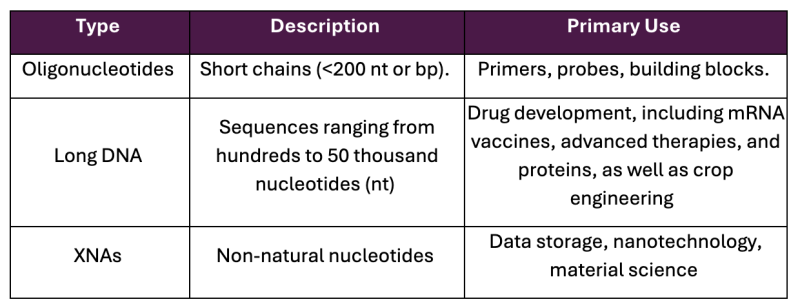
Oligonucleotides: These are short, linear DNA or RNA molecules often referred to as oligos. They can be assembled to form longer double-stranded DNA molecules.
Gene Fragments: These are longer double-stranded DNA molecules that can be used to manufacture proteins. There is no cut off for when a DNA molecule is considered long, but typically, above 3-5 kb is considered longer and we manufacture up to 12 kb long linear DNA and 20 kb circular DNA.
DNA and RNA Origami: Synthetic DNA used as a material to create nanostructures are a promising development. These structures are folded DNA molecules that can be used for transporting drugs and shaping our understanding of biology on the nanometer scale. RNA origami can be used to create synthetic cells and cellular structures like filaments or microtubules.
Xeno Nucleic Acids (XNAs): Synthetic DNA architectures that utilize non-natural backbones or non-natural nucleotides, such as Hachimoji DNA, which has potential use cases in data storage. Summary of Synthetic DNA Types
The applications of synthetic DNA
Synthetic DNA has numerous applications across the drug development continuum, from pre-discovery research to diagnostics. Outside of biopharma, it can be used in the genetic engineering of crops, biofuel production, and data storage.
Pre-Discovery Research
Synthetic DNA is a versatile tool that allows researchers to understand the function of specific genes and cells.
Synthetic genomes can produce viable microorganisms for modeling biological systems in the lab.
Drug Development:
- Long double-stranded DNA (dsDNA) is used to manuacture recombinant proteins, antibodies, and enzymes.
CRISPR and Gene Editing:
- Accurate DNA improves the precision of gene editing by guiding the double-strand breaks (DSBs) at the right locations
mRNA therapies:
- Used as the template for producing mRNA vaccines and other RNA-based therapies.
Gene therapy
- Enzymatic and chemical DNA synthesis allows for the manufacturing of viral vectors without the need for traditional bacterial fermentation
- For CAR T cell therapies, customized DNA sequences help manufacture the AAVs or lentiviruses used to create personalized cell therapies.
Companion Diagnostics
- Synthetic oligonucleotides act as highly specific probes for molecular detection and medical diagnostic applications.
- Biofuel production and Agriculture
- Researchers synthesize large polyketide synthase gene clusters to develop biological solutions for resource sustainability
- Synthetic DNA can be used to engineer crops with desirable traits
Data storage
- DNA serves as a permanent and compact medium for storing vast amounts of digital information at low energy.
- Expanded eight-letter genetic alphabets are being used to exponentially increase the density of data storage in DNA


